2026 Symposium
Law, Technology, and Society: Charting the Next Frontier
April 15, 2026
Room 6, Hulston Hall, University of Missouri campus
The Business, Entrepreneurship & Tax Law Review (BETR) Spring 2026 Symposium, “Law, Technology, and Society: Charting the Next Frontier,” brings together scholars, practitioners, and interdisciplinary experts to examine the rapidly evolving relationship between artificial intelligence, law, and public institutions.
Through keynote presentations and collaborative panel discussions, the symposium explores emerging legal, economic, and societal challenges created by AI—including academic integrity, legal ethics, First Amendment theory, democratic governance, and liability for algorithmic harms. The program features contributions from faculty and researchers across multiple disciplines, including law, journalism, public affairs, and constitutional democracy, reflecting BETR’s commitment to fostering dialogue that bridges legal scholarship with real-world policy and technological developments.
By combining doctrinal analysis, empirical research, and practitioner insight, the symposium aims to advance thoughtful solutions to the complex legal questions posed by artificial intelligence and its growing influence on modern society.
Attendees are eligible to earn 7.2 total Missouri CLE credits and 2.4 ethics credits.
Mizzou students are eligible to earn 1 Professional Identity Credit, and Edge Points through the Business School. Students may earn a maximum of one Professional Identity Credit regardless of how many sessions they attend.
Schedule
8:00-8:45 a.m. Breakfast
8:45-9:00 a.m. Opening Remarks — Kiera Doughty, BETR Editor-in-Chief and Claire Kelly, BETR Lead Articles Editor
9:00-10:00 a.m. Academic Integrity, Student Discipline, Due Process, and Privacy in the AI Age — Professor Ben Trachtenberg & Professor Anne Alexander
Professors Ben Trachtenberg and Anne Alexander will present on the challenges that advancements in AI technology pose for academic integrity and student discipline in higher education. Their discussion will explore how emerging technologies are reshaping due process considerations and raising new privacy concerns in the investigation and adjudication of academic misconduct. The session will include individual remarks followed by a joint Q&A discussion.
10:00-11:00 a.m. The Lawyer’s Swan Lake: Generative AI, Legal Epistemology, and the Nondelegable Duty to Think — Angie Zinzilieta
Angie Zinzilieta will present over her paper, which argues that the central risk of Generative artificial intelligence (“GAI”) in legal work is epistemic atrophy. Ms. Zinzilieta proposes a contemplation-first framework for attorney’s ethical AI use, especially in plaintiff-side litigation.
11:00-12:00 p.m. Beyond the Prompt: The Social Cost of Generative Artificial Intelligence — Professor J. Scott Christianson and Josh Rickard
Professor J. Scott Christianson will present over his paper, Beyond the Prompt: The Social Cost of Generative Artificial Intelligence. His paper reviews three domains in which AI produces systemic external costs onto society: environmental, human health, and digital infrastructure. His article argues that the AI industry’s business model is predicated on the privatization of benefit and socialization of cost, and that those who generate these risks must bear cost of extraction, defense, and human harm to prevent AI from levying this tax on the broader economy.
12:00-1:00 p.m. Panel 1: The Impact of Artificial Intelligence on Democracy, Constitutional Values, and the Public
Professors from Mizzou Law, the Kinder Institute on Constitutional Democracy, the Truman School of Government and Public Affairs, and the School of Journalism will discuss artificial intelligence’s impact on jurisprudence, First Amendment Theory, trust in democracy, and the media.
1:00-2:00 p.m. Break
2:00-3:00 p.m. A Synthetic Marketplace: Rethinking First Amendment Theory in the Age of AI-Generated Video — Professor Jared Schroeder
Professor Jared Schroeder will present over his paper, A Synthetic Marketplace: Rethinking First Amendment Theory in the Age of AI-Generated Video. His paper examines the nature of synthetic media and outlines historical understandings of truth, trust, and legitimacy in the context of visual media and Supreme Court rulings. Professor Schroeder’s paper concludes by providing a framework for how lawmakers can address the threats to truth and reality caused by AI-generated, synthetic media while still respecting First Amendment safeguards for freedom of expression.
3:00-4:00 p.m. Panel 2: The Spread of AI Policy and Liability for AI-Related Harms
Professors Renee Henson and Scott LaCombe will speak about the rise in AI use and policy and discuss liability theory for AI-related harms.
4:00-4:15 p.m. Closing Remarks — Kiera Doughty, BETR Editor-in-Chief and Claire Kelly, BETR Lead Articles Editor
____________________________________________________________________________________________________________________________________________
Past Symposia
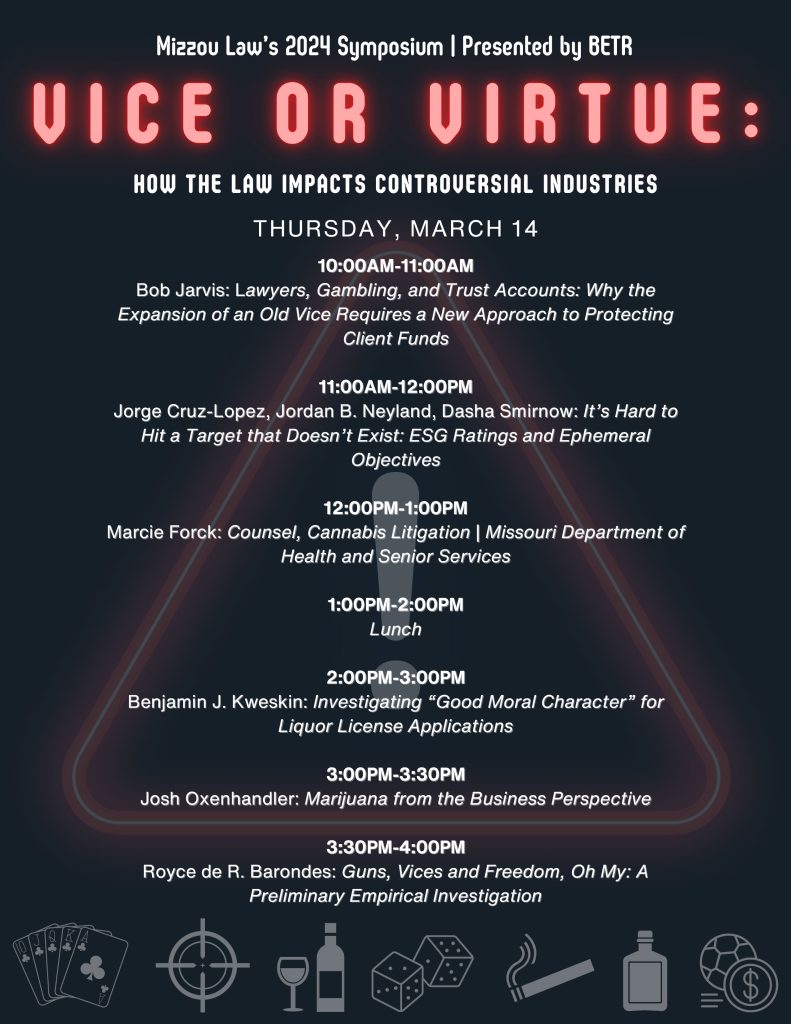
2024 Symposium
BETR is hosting a symposium March 14, 2024 which explores controversial areas of the law. Areas that some may consider morally abhorrent will be a part of modern-day Americana in some form—the business and legal implications are too important to ignore. Gambling, marijuana, firearms, and alcohol are a few topics we will explore with the guidance of legal academics and practicing attorneys. CDO professional credit will be offered for this event. Additionally, there will be CLE credit offered for the event, including CLE Ethics credit, so feel free to share this invitation with attorneys in your life. There will be both in-person and Zoom options.
BETR is absolutely thrilled to host practitioners in the field to share their unique perspectives on law and the practical applications to controversial industries. I encourage you to look at the attachment to this email to see a lineup of the speakers and topics. During the lunch hour, you will have an opportunity to talk to the speakers in a less formal setting. I invite all of you to join BETR as explore new and exciting areas of law.
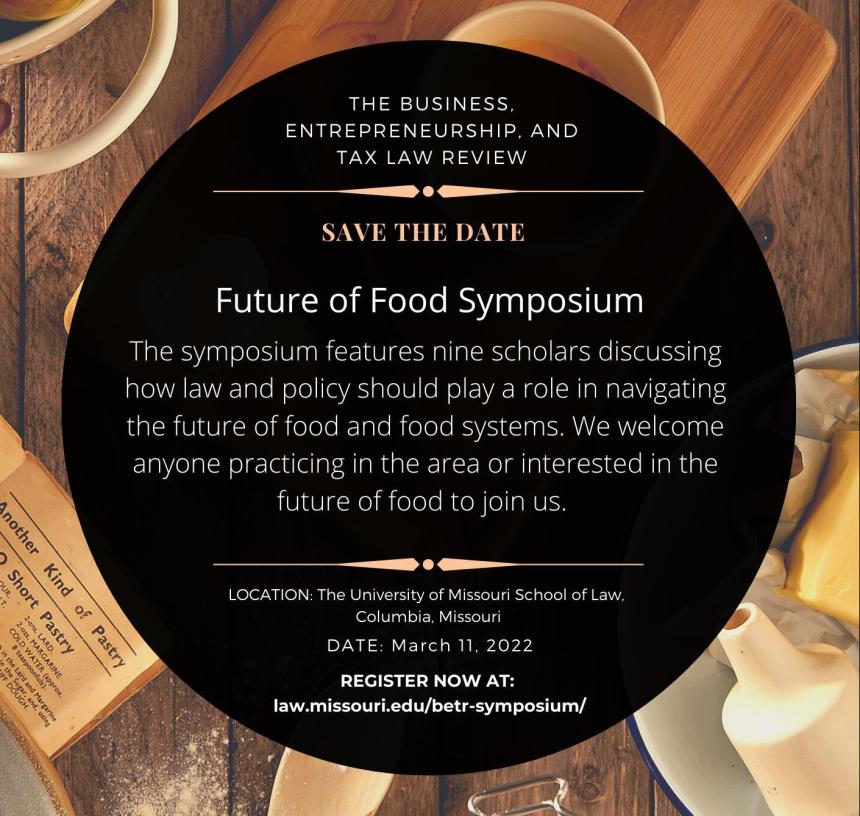
2022 Symposium
The Business, Entrepreneurship, and Tax Law Review hosted a free symposium available both in-person and virtually, on the Future of Food. The symposium featured nine industry practitioners discussing how law and policy should play a role in navigating the future of food and food systems.
2019 Symposium
Protecting the Public While Fostering Innovation and Entrepreneurship: First Principles for Optimal Regulation
A symposium hosted by the Center for Intellectual Property & Entrepreneurship and the Business, Entrepreneurship & Tax Law Review, with support from the Koch Foundation.
In this symposium, a distinguished group of panelists considered both substantive principles for regulating effectively in particular areas (e.g., financial markets, telecommunications, prescription drugs, network technologies) and broader procedural questions about how regulations should be crafted.
Keynote Address
Commissioner Hester Peirce of the U.S. Securities and Exchange Commission (SEC) delivered the keynote address. Drawing on Professor Thom Lambert’s recent book, How to Regulate: A Guide for Policymakers, Commissioner Peirce discussed the difficult issues the SEC faces in regulating “initial coin offerings” (ICOs) and the trading of cryptocurrency-based funds. Commissioner Peirce’s remarks have already garnered the attention of a number of cryptocurrency-focused news outlets, including CoinDesk, CoinTelegraph, and UK-based MondoVisione. Her speech has been published in full in BETR’s Spring 2020 publication, and can be found at 3 Bus. Entrepreneurship & Tax L. Rev. 267.
2018 Symposium
Innovation in Media and Entertainment Law
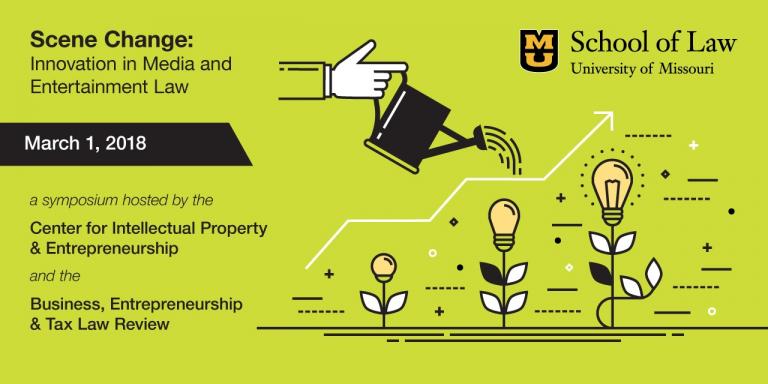
Featured speakers included Jim Spencer, founder of Newsy, and First Amendment Expert Dean Larissa Lidsky (among others). Our dynamic keynote speaker was Jim Spencer, founder of Newsy. The event was sponsored by the law journal BETR (The Business Entrepreneurship and Tax Law Review) and CIPE (The Center for Intellectual Property & Entrepreneurship).
2017 Symposium
Implementing and Interpreting the Defend Trade Secrets Act of 2016
Trade Secrecy
With its common law origin, trade secrecy has long been an integral layer of intellectual property protection. Trade secrets are broadly defined as confidential business information whose secrecy provides an operator with economic advantage. These may include technological information that overlaps with patent rights such as manufacturing techniques or software code, but trade secret protections also extend to pure business information such as customer lists and profit margin information that are not protectable under other IP regimes. The use of “improper” means to uncover another’s trade secret is ordinarily deemed an actionable misappropriation under both civil and criminal law. Most trade secret cases involve situations where an employee has left to join (or found) a competitor. Those cases draw in employment and contract law issues and challenge the fundamental nature of a competitive market.
Defend Trade Secrets Act
In 2016, a bipartisan majority of Congress enacted the Defend Trade Secrets Act (DTSA) that provides for a federal civil cause of action for trade secret misappropriation as an additional layer to the individual state rights already in existence, as well as for a new seizure order mechanism. Many factors remain unclear. How does the new law integrate with other state law doctrines after considering the federal supremacy clause of the U.S. Constitution; how will the seizure orders be implemented; while overlapping, are the federal trade secret rights distinct from state rights; can the federal trade secrecy rights also protect individual privacy?
Symposium Program
Featured Speakers included Berkeley Law Professor Peter Menell and Trade Secrets Expert Mark Halligan (among others). Our dynamic keynote speaker was Professor Orly Lobel from the University of San Diego. Professor Lobel is the author of the great book Talent Wants to Be Free. The event is sponsored, in part, by our new journal BETR (The Business Entrepreneurship and Tax Law Review). The focus is partially on protecting information – but also employment law and competition issues that ensue.